
1. The Program
HSM Est. Quality Control Program is for this project called the Contractor Quality Control System; it is a program of policies, procedures and detail responsibility required to ensure that the materials and components of the project will be constructed satisfactory in conformance with applicable contract standards, in order to accomplish the task professionally.
It compromises of systematic actions necessary to provide that items procured, manufactured, fabricated or constructed and services rendered by HSM Est. are accordance with applicable contractor requirements.
It is the philosophy of HSM Est. that quality must be planned and built into product or activity, and verified by means of review, inspection and testing by QC Supervisor.
The management emphasizes the principle that every individual is responsible for the quality if the work that he performs, even though the work may be verified by independent QC Inspector at any stage of processing to assure conformance with applicable specifications.
2. The Program Structure
The contents of the QC Program consist of detailed written statement of policies and procedures in relation to specifications, drawings, materials, tests and documents.
The program is documented in the form of a QC Manual consisting of two main parts:
- a. QA/QC Manual Part 1 = Program / Policies
- b. QA/QC Manual Part 2 = Procedure
This manual has been structured and developed to illustrate the control practices during project execution in terms of information, materials and personnel in three basic phase namely:
a. Preparatory Phase
b. Initial Phase
c. Follow up Phase
The detailed break up of this structure is shown in the Quality Control Manual.
This Quality Control manual (QCM), has been prepared to describe the QC Program and Procedures for HSM Est. activities, and will be the overall document in the program. The QC Manual is the overall document which describes the general quality requirements and the principles for accomplishments.
QC Procedures describe the practical accomplishment of the QC requirement related to the different activities of the project in conformance with applicable specifications and drawings. The details of the manual are laid out in Part 1 and Part 2.
Contractor quality control (cqc)
This is a QC System of inspection and control to be followed by all QC personnel in the company to ensure that all necessary aspects of quality are in accordance with contract.
This system covers the applicable aspects of quality both on-site and off-site. This system follows the HSM Est. QC Program structure as described earlier. The objective of CQC is to ensure for this project the following aspects:
- Work performed under this contract conforms to all applicable contract requirements.
- Perform sufficient inspection and tests of all times of work, including the HSM Est. sub contracts to ensure conformance to applicable contract plans, specifications and drawings in respect of materials, workmanship and performance.
- Maintain inspection records and make them available to the client when required.
- Provide necessary support for any inspection test that the client may want to perform at the site.
- Conduct phased inspection namely the Preparatory, the initial and Follow up inspection in accordance with the relevant clauses of the contract.
- Review and approve the shop drawing prior to submittal to the client.
- Conduct on-site and off-site inspection on all materials, suppliers and services to be incorporated into the works.
h. Keep all test equipments calibrated as per standards and norms. - Prepare, maintain and submit inspection reports in accomplished work as specified contract. Make available to the client when required, these reports to show the following details:
- Inspection / Test made on materials in relation to the phase of work accomplished and upon arrival at site before incorporation to the work.
- Identification of any defects and the accessory remedial / corrective action.
- Identify the inspection done on-site and off-site.
- Reflect into the inspection client any prior instructions received from.
- Use independent test laboratory to conduct tests when necessary.
- To keep the client informed of change in QC system if any.
- To implement procedures for analysis, correction and feedback of failures and also corrective / preventive actions in accordance with correct requirements.
This system follows the general guidelines of HSM Est. Quality Control functions as described in the following pages.
3.1) Definitions:
The terms abbreviations listed below are contained in this document and are defined as follows:
- Audit – a document activity performed to written procedure or checklist to verify that selected elements of a Quality Program has been developed, documented and implemented in accordance with specified requirements.
- Certification – a written attention attestation that applicable requirement was met, stating the details of verification (e.g. review; inspection; test, witness), which is designed and or stamped and dated by the certifying party.
- Information Documents – drawings, specifications, date-sheets, calculation, records, reports and other documents which are used in design, procurement, fabrication / installation, testing and examination.
- Non-conformance – a deficiency in characteristic, documentation or procedure items that deviate from specified requirements.
- Quality Control Program – the planned and systematic management of actions necessary to provide adequate confidence that an item or facility will perform satisfactory.
- Quality Inspection Control – the acts of examining, witnessing, checking and or testing to determine conformity with requirements and documenting the results.
4. Quality Control Functions:
The QC Department (QCD) is established as a part of the Technical Support Group, being a HSM Est. Management activity. The head of the department has authority and responsibility to implement the requirements of the Quality Control Program. He is free to discuss and analyze any problems arising from quality control and inspection activities, at any level in the organization. He is responsible to obtain necessary QC equipment and qualified personnel to accomplish the QC Program (QCP).
The main responsibilities of the QCD are to establish and implement the
Quality Control Program (QCP) in the organization, and to:
a. Ensure that job procedures are implemented at the site organization.
b. Ensure that operational procedures are established according to applicable codes and contract requirement.
c. Ensure that operators are qualified, and that the necessary records of qualifications and performance are maintained.
d. Ensure that workmanship level is maintained as per the company and is acceptable.
e. Ensure that inspection and testing activities are carried out in accordance with approved procedures, and to the extent specified in contract documents.
f. Record and file the results of testing and inspection activities, and prepare for acceptance by the client.
g. Carry out audit to verify compliance with routines and procedures.
The head of the Quality Control Department, in consultation with the Project Manager, nominates QA/QC personnel on each
construction site for the performance and adherence to the Quality Program.
5. Quality Control Organization
The key site person heading the QC team at each site designated as the QC Engineer and report to the head office above the level of Site Engineer / Superintendent.
The head of the QCD is responsible to the Project manager of HSM Est.
developing, implementing and maintaining QC Program.
The Quality Control Department, also known as Chief Quality Control Engineer (CQCE) will be qualified engineer having experience of more than ten (10) years in construction / quality control and report to Project Manager. There will be one QC Engineer for each project site. He will be assisted by QC inspector at each site if required. The reports from QC Engineer always copied to Project Manager in a daily / weekly basis.
6. Responsibility and Authority
HSM Est. Project Manager has the ultimate responsibility for accomplishing specified quality level of HSM Est. activities thru the QCD and the QCD is responsible for obtaining suitable equipment and qualified personnel to accomplish specified quality of fabrication and construction.
Chief QCE / QC Engineer / QC Inspector is responsible for the verification that procedures and instructions are followed during fabrication and construction. Site Manager / General Foreman / Site Foreman has the responsibility to make sure that each operator is responsible for using valid production and to perform the work in accordance with the documents therewith.
They are further responsible for the quality of their own work.
The head of Quality Control Department (QCD) has the responsibility to prepare necessary control to test procedures. Further they will check and approve all process description and work instruction to assure that all inspection and testing are correctly incorporated regarding time and sequence.
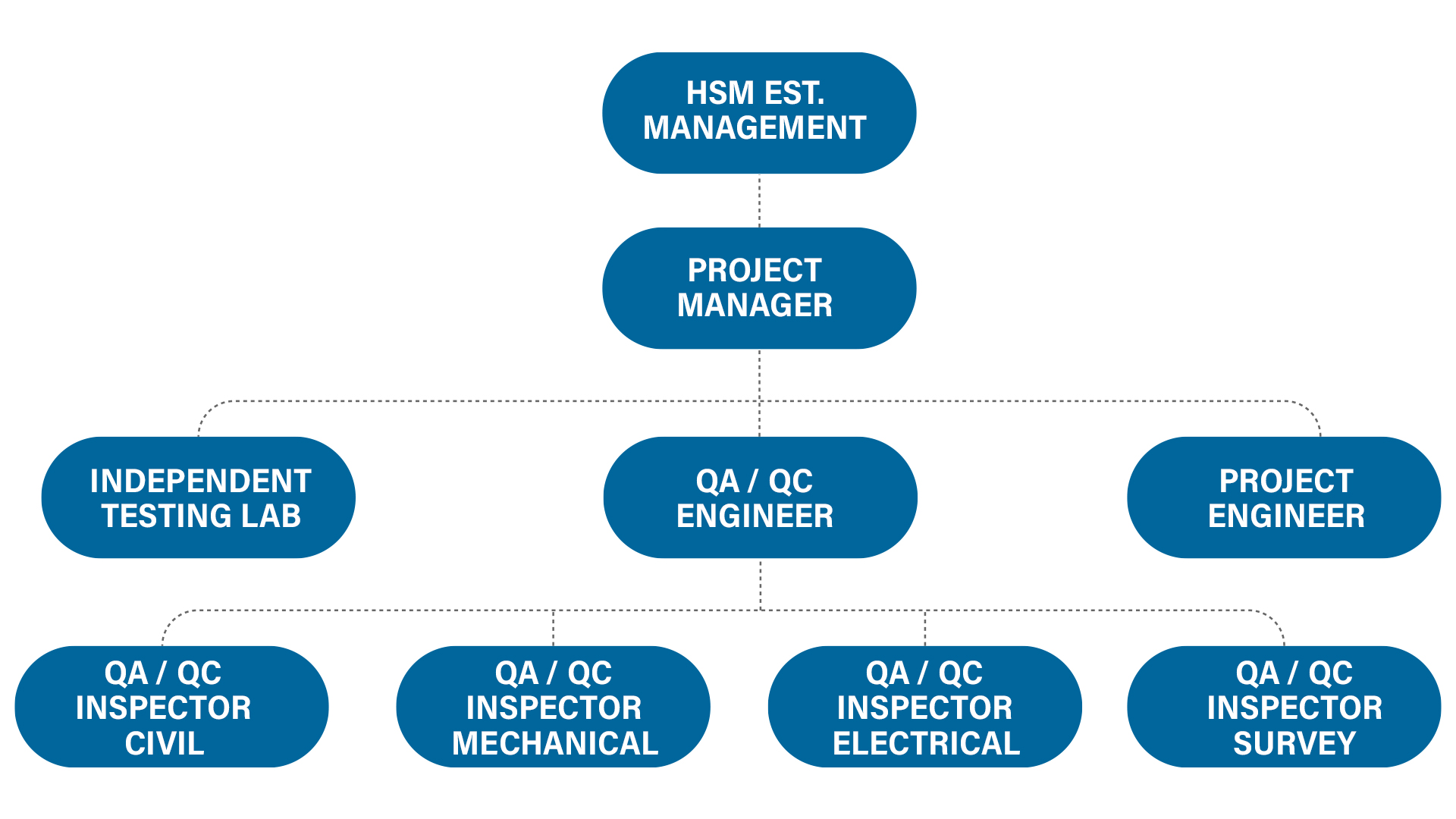
The following organization chart outlines the QC/QA structure:
6.1) Responsibility of Chief QCD includes organizing the following:
- Training and testing technicians to appropriate code.
- Preparation of procedures and job instructions for QC Personnel.
- Equipment calibration control and documentation.
- Checking / verifying contracts and shop drawings before submittal to client and release for execution.
- Designing and implementing, recording and reporting formats for QC works.
- Inspect / verify all work against specification and approved shop drawings.
It is the responsibility of the Project Manager to make sure that operations, which need to be certified in accordance with applicable codes and contract requirements and specifications and procedures issued for construction, in consolation with QC Personnel. He will ensure that:
- The type of quality materials to be used are properly indicated on drawings and material listed, necessary drawings for material tractability are prepared, no one other than the QC Engineer has the authority to make any decision relating to quality matter, deviation without exception are referred back to the Head QCD and Project Manager who might need to take the occurrence of the client in certain cases.
- The quality control requirements are indicated of the final drawings in terms of the tests to be carried out and specification to be followed.
7. QC on Vendors and Sub-Contractors
7.1) Vendor and Sub-Contractor Evaluation:
It is primary responsibility of the QC to monitor the quality level vis-à-vis contract requirements for all vendors and sub-contractors. QC must review, evaluate and ratify each vendor critically before purchases are authorized on specific vendors.
HGC requires all its sub-contractors to perform QA / QC under the supervision of the assigned HSM Est. QC Inspector / Engineer and report the results of the inspection to the Head QCD.
The qualification of vendors and sub-contractors is based on previous experience, inspection visit standards and reliability of the company and its procedures.
The extent of the follow-up inspection performed by HSM Est. Personnel or by a third party, designated by HSM Est. will depend on:
- The type of supply.
- The importance of the item.
- The extend of vendor’s own inspection.
- The Quality Program of the vendor.
The Quality Control Personnel will review inspection reports by the vendor and approved these if the reports are in accordance with the client specification.
The inspector shall perform the final inspection prior to shipment to assure that only approved material is being shipped. All accepted items are marked to avoid any mix-up.
8. QC Inspection System
Scope:
This section outlines the methods and requirements for Quality Inspection. The purpose to the function described herein is to verify the conformance of the contractual specifications and the generally accepted level of workmanship. Main objectives of inspections are the visual, dimensional and quality testing, surface and the like. They are detailed out in the following sections:
8.1) The HSM Est. Inspection System:
The QC Inspector will inspect, monitor and ensure that fabrication and construction is accordance with contract requirements and specification controls include at the minimum three types of inspection namely:
A. Preparatory Inspection
The inspection shall by perform prior to beginning any work on any definite phase of construction and as shown on the construction schedule, it shall review:
- Contract requirements against actual quality of materials received to make sure they are as per specified items.
- To make sure the items are per shop drawings, which are approved.
- To ensure that all items are in accordance with submittals, which are approved.
- To inspect the work areas to ensure that all preliminary work has been completed in accordance with requirements.
- To ensure that inspection is done and is made a matter of record in HGC documentation.
B. Initial Inspection
The inspection is done as soon as a respective portion of the particular phase of work as shown in construction schedule has been accomplished.
The inspection shall establish the acceptable standard of workmanship and includes a review of control testing for compliance with contract requirements. It will take into account relevant all the QC procedures relating the inspection of the relevant portion of the work. Once this is portion is acceptable by CQC, the client is notified.
C. Follow-up Inspection
The inspection will be performed finally on a daily basis to ensure continuing compliance with contract requirements, including the control testing until completion of the particular phase of construction. Such inspections shall be made a matter of CQC documentation.
A periodic QC report is prepared and put on record. The client is given a copy of the report as may be necessary.
8.2) Visual Inspection
Visual inspection is considered as an important part and place during all fabrication and installation phase, and is performed in accordance with the practice of good workmanship and to meet applicable codes, specifications and procedures. The inspector will have available the relevant documents pertaining to work.
When performing the final inspection, he will provide a record of the inspected items, in case non-conformance a punch list will be complied for further actions.
8.3) Dimensional Inspection
The QC Engineer according to the contract requirements and the site situation will establish the extent of dimensional control. In general, the Site Engineer is responsible for adequate dimensional control and ensuring that all items are assembled within specified reference.
The quality Inspector shall prepare the dimensional control documentation, and in cooperation with the QC Engineers to include the information in the “As-Built” drawings.
8.4) Leak Testing
Leak testing and Hydrostatic Testing of tanks, vessels and piping system will be performed according to written procedures, and in compliance with code requirements and contract specification. The test system will be blinded, calibrated gauges will be fitted.
Normally, water containing corrosion inhibitor of specified, will be utilized for testing. When all air pockets are vented, the pressure will be raised slowly up to the design pressure, and all joints/ connections will be inspected for leaks.
Correction of any leakage will be carried out and the pressure then rose to full hydrostatic test pressure during testing, which shall be maintained for a period specified in the test procedures
A visual inspection of all joints will be performed. There should be no leak and drop of pressure during testing.
Temperature and pressure of the test media may be recorded during the test, and will be compared with the pressure readings required as per the test procedure.
If the test is found acceptable, the pressure test report and other documents will be prepared and signed by the inspector and QC Engineer.
8.5) Surface Treatment
An appointed inspector will make the necessary inspection to assure adequate quality and if specified, prepare documentation for performance including the following data:
- Cleaning surface i.e. degreasing, grinding, sandblasting etc.
- Wet-film thickness
- Curing and hardening time
- Control of ambient temperature and relative humidity
- Anchor pattern, roughness of surface
- Viscosity
- Visual inspection results
The inspector will assure that the approved procedures are adhered to in performing regular and random inspections. He is responsible for reporting of the work, and shall cooperate with the QC Engineer to insure that these reports from a part of the final documentation.
8.6) Calibration of Measuring and Test Equipment
A system of calibration and maintenance of test and inspection equipments is established and related for example to Pressure Gauges; Temperature Measuring; Recording Units and Similar.
The calibration are carried out according to set system procedures which include data such as calibration schedules, accuracy required, authority for performing the calibration, type of documentation required and person responsible for approval of the test calibration results.
9. Non-Conforming Material and Items
Scope:
HSM Est. has established a system for the control of non-conforming items. This system covers identification, removal, and corrective actions to preclude repetitions of non-conformance and the documentation of these activities.
9.1) Non-Conformance
All items; services or activities, which do not conform to the valid specified requirements, would be assessed as non-conformance.
Measurements to be taken for non-conformance items will include visual and dimensional inspection, testing, appropriate identification, documentation, segregation and notification to affected party.
Identified non-conformance will be marked according to written procedures and reported though a non-conformance report.
Actions on non-conforming items may be:
- Accepted as is
- Reworked to meet specification
- Repaired to other approved specification
- Scrapped
- Returned to supplier for further action
9.2) Responsibility and Authority
Whenever non-conformance in required quality are discovered or suspected at receiving inspection or during the manufacturing process, during assembly or final testing, HSM Est. Personnel will promptly report these to the foreman, supervisor or responsible engineer for corrective action. All reports relating to non-conformance will be submitted to the QC Control Engineer / Head QCD / Project Manager.
The Site Engineer has the responsibility for making the necessary arrangements for removal of the non-conformance. The involved project personnel have the responsibility to accomplish the agreed action.
The Quality Engineer has the responsibility to verify the effectiveness of the corrective action.
9.3) Treatment of Non-Conformance
Items, which do not comply with the contract requirement, are segregated from acceptable items and clearly marked to preclude further processing until the discrepancy has been reviewed and solved.
Items, which are found deviate from specifications and cannot or will not be reworked to comply with specifications is considered to be non-conformance.
A report documenting the non-conformance will be made by the QC and will suggest the same remedial actions. Upon completion of remedial actions, the materials are subjected to the same quality control routines as a new receipt.
In the case of significant conditions adverse to quality, the quality inspector will ensure that the cause of the condition is determined and corrective action taken with subsequent follow-up to preclude repetition.
9.4) Non-Conformance Documentation
Non-conformance will be documented by the QC Engineer and will consist of, as applicable:
- Report of Non-Conformance
- Corrective Action Report
Copies of these reports are marked to HSM Est. Management for evaluation.
10. Audits
Scope:
This section establishes a system of quality audits to determine the effectiveness of the quality program and to document the observation.
10.1) Responsibility and Authority
The responsible of the internal audit of the quality control activities at the field sire rests with the quality control inspector in cooperation with Head QCD.
10.2) Execution Audits
Planned periodic audits are performed at two distinct levels to assure compliance with all aspects of the quality control program to determine the effectiveness of the program. The audits are performed in accordance with written procedures by personnel, not having direct responsibilities in the areas of being audited.
The first level audit is a continuous audit that is performed by the QC Inspector on a day-to-day basis. As discrepancies in the program arise, they are reported to the quality control engineer. He evaluates the situation and takes corrective action within the scope of his responsibility. All such situation is brought to the notice of Head QCD / Project Manager.
The second level of audit is random audit conducted by the quality control engineer and a team consisting of the Site Engineer / Head QCD and the Site Manager to determine the effectiveness of the QC Program.
The audit will be conducted at irregular periods and at random, but shall be carried out when one or more of the following condition exist:
- When significant changes are made in functional areas of the quality control program. Including significant reorganization and process revision.
- When a systematic, independent assessment of the program effectiveness or item quality, or both, is considered necessary.
- When it is considered necessary to verify implementation of required corrective action.
11. Documentation
Scope:
This section establishes a system that assures necessary identification, preparation, review, approval, issuance, distribution, updating and filing of documents and information including the shop drawings.
11.1) Responsibility and Authority
The project organization is responsible for the establishment of necessary procedures and instructions for the implementation of the documentation system, in cooperation with site in-charge and Head QCD.
Quality Control Department has the responsibility to prepare and distribute to project departments involved final documentation as specified by client and is further responsible for collecting the final documentation, obtaining client’s approval and maintaining these documents in files for the time period as specified.
The client will have access to file of final documentation.
11.2) Documentation System
The established documentation system includes control of all required documents traceable to detail design, purchasing of items, manufacturing process, assembly test and delivery of completed product according to the procedures. This system will provide for:
- Review and approval of all shop drawings and changes by QC.
- Identification of documents for performing each activity, which affects quality.
- Controlled distribution to assure that proper documents are being used in each activity, which affect quality.
- Ensuring that changes of documents are made only after review and approval.
Final documentation will include, but not limited to the following:
- “As-Built” Drawings
- Dimension Control Reports
- Surface Preparation Reports
- Pressure and Leak Test Reports
- Corrective Action Reports
11.3) Approval of Documents
It is the responsibility of the QC Engineer and Head QCD to review and approve the following documentation before submitting to the client:
- Technical Specifications
- Approval for Construction Drawings
- Shop Drawings
- Cut List / Material List
- Fabrication / Erection procedures
- Inspection Procedures
The QC Engineer is responsible for the distribution of these documents to all concerned parties according to established distribution routines.
12. Qc manual part ii – qc procedures
Scope:
As stated earlier the Part I of the manual comprises of the QC Program / Policies, which specifies the objectiveness of the QC Program and its details.
The Part II, if the manual related the QC procedures through which the program implementation is monitored and the control procedures for typical work included HGC scope of work are discussed in the following pates. The procedures from HSM Est. QC Manual, general guideline embodied for each type of the work but the specific details will be the work during the practical inspection at the site. The necessary record formats for each specific requirement will be designed and implemented at the appropriate time. Similarly reporting format will be designed and implemented by the Head QC in consolation with the client as the work proceeds.
In the following pages the guideline procedures are discussed for the following type:
- Civil Work including Structural
- Masonry Block Work
- Piping Work including Mechanical
- Electrical Work including Instrumentation
12.1) Inspection Procedures for Civil Work
In conjunction with the HSM Est. QC Manual, the following inspection procedures are to be observed during the execution of the civil work.
Preparatory inspection
Inspection Site Clearance
- Inspect final grading for soft spot, rubbish, scrap or any other foreign materials.
- Verify datum and finished grade level, check soil analysis.
- Insect and report on test results.
- Mark-up plan showing location of in site test.
Inspection Prior to Placing Concrete
- Inspect formwork, reinforcing steel and embedment items as work progress.
- Check that test results of soil on which concrete will be placed are in compliance with project requirements. Check that subsurface treatment e.g. blinding concrete or vapor barriers have been placed.
- Check formwork for strength, line and level and surface finish.
- Horizontal and vertical construction joints have been cleared and surfaces wet down and cemented before fresh concrete be placed.
- Check method of placement and ensure vibration equipment is adequate for correct compaction of the concrete.
- Ensure that curing materials are available.
- Concrete cover and spacing are maintained.
- Reinforcing steel has projections for splicing in subsequent pours.
- Check dimensional accuracy of all embedded items and insure that bolt threads are greased.
Initial inspection
Inspection Backfilling and Compaction
- Inspect source of supply of fill materials to ensure materials is in accordance with project specifications.
- Check thickness on fill layers and verify proper compacting method.
- Ensure that frequency and type of test meets project requirements.
- Review and documents the results of all soil analysis and compaction test.
Inspection Reinforced Concrete
- Prior to any work being carried out in the construction of reinforced concrete works, a quality control engineer will ensure that a materials laboratory has performed analysis of cement and sand and water, rebars and aggregates to ensure materials used meet project requirements.
- Ensure that the batch operations comply with project requirements. Check the general requirements as follows:
b.1) Correct quantity and quality of cement used.
b.2) Admixtures are used when necessary.
b.3) Materials storage adequate
c. Prepare documentation as of the following:
c.1) Daily and weekly concrete schedules are prepared.
c.2) Complete concrete pour card for each schedule.
c.3) Documentation and test result manual.
Inspection and Test during Concrete Placement
- Witness Slump Test
- Ensure samples taken for cylinder test are properly taken.
- Check concrete delivery ticket to ensure concrete is place within the require time.
- Concrete is sufficiently vibrated to prevent pockets, especially at corners, embedment and block outs.
- Rate of placement is controlled to prevent cold joints due to excessive time between lifts, or steps.
- Placement method prevents segregation and meets project requirements.
12.2) Quality Control Program of Masonry
In conjunction with HSM Est. Control Manual the following procedures is to be observed during the execution of masonry works.
Preparatory Inspection:
- Ensure that source of supplying material is in accordance with the project specification.
- Verify the finished grade levels.
- Review the drawing, plan to check and make sure the layout is correct.
- Ensure that concrete mixers are in working condition and all materials are adequate.
Initial Inspection:
- Ensure that specified curing medium is used and the correct procedures are applicable.
- Ensure that strutting system remains in place until the concrete has attained sufficient strength.
- Ensure those block walls are horizontally / vertically in line, level and plumb.
- Record the results of the test for masonry works.
12.3) Inspection Procedures for Pipe Work
In conformance with HSM Est. Quality Control Manual the following procedures is to be observed during execution of pipe work.
Preparatory Inspection:
- Ensure that all pipe work and associated fittings are in accordance with the project requirements.
- Ensure that safe method of lifting line pipe is used to prevent damage.
- Ensure that storage of delivered materials is adequate.
- Before laying pipe in excavation, check that specified bedding layer has been placed.
Initial Inspection:
- Ensure that coat and wrap materials is in accordance with project requirements.
- Check that pipe is cleaned, coated and wrapped in accordance with project requirements.
- Ensure that all in-site joints are cleaned of weld and foreign objects before coat and wrap operation.
- Conduct in-site holiday testing of all exterior coated and wrapped underground pipe work.
- Ensure that all repairs are carried out in accordance with repair procedures.
- Inspect joint set-up and ensure that method of jointing is in accordance with project requirements.
- Ensure that stop valves as provided in the main water pipe to have control on the distribution of connecting pipes.
Follow-up Inspection:
- Prior to hydraulic testing carry out a visual inspection before pressurization to ensure conformity with test requirements.
- Ensure that test is carried out to pressure and duration’s required by the test schedule.
- During test pressure duration inspect all welds and joints.
- Notify owner of hydraulic testing prior to commencement of the test. All testing be witnessed by an owner’s representative and signed off by him.
- Any leaks discovered shall be repaired and the test re-run should be applied. Test pressure shall be removed prior to commencement of leak repairs.
- Ensure cleaning and flushing of all pipe work subsequent to testing. Flushing to be continued until satisfactory degree of cleanliness is obtained. Sterilization of portable water lines to be carried out as project requirements. Document the results of inspection on the check attached.
12.4) Inspection Procedures for Electrical Work
In conjunction with HSM Est. Control Manual the following procedures use to be observed during execution of electrical work.
Preparatory Inspection:
- Ensure that all electrical equipment is in accordance with project requirements.
- Ensure that performance certification is available for high voltage cable splicers.
- Check that all conduits; ducts, and ground wires associated with civil work have been correctly placed.
Initial Inspection:
- Ensure that excavation is to correct depth and proper bedding materials are used.
- Check that correct radius is used for bending cables at corners.
- When making connections to existing system, ensure that proper de-energizing procedures is observed.
- Check cable terminations for compliance with project requirements.
- Inspect installed cable conduit to ensure that cable can be pulled easily and without damage.
- Inspect laid cables or links, damage, proximity to pipes and sufficiently if cable left coiled for connections.
- Inspect cable joints to ensure that correct materials and joining procedure are observed.
- Inspect fill material to ensure it contains on material injurious to that cable.