
It is the policy of our company to attach the greatest importance to the prevention of any form of loss and in particular, to the safety of its employees. It is the duty of all levels of management to do everything within its authority to prevent injuries to personnel and to minimize loss. It is equally the personal duty of every employee to do everything possible to avoid injury to himself and to others, and to minimize any form of loss within his control.
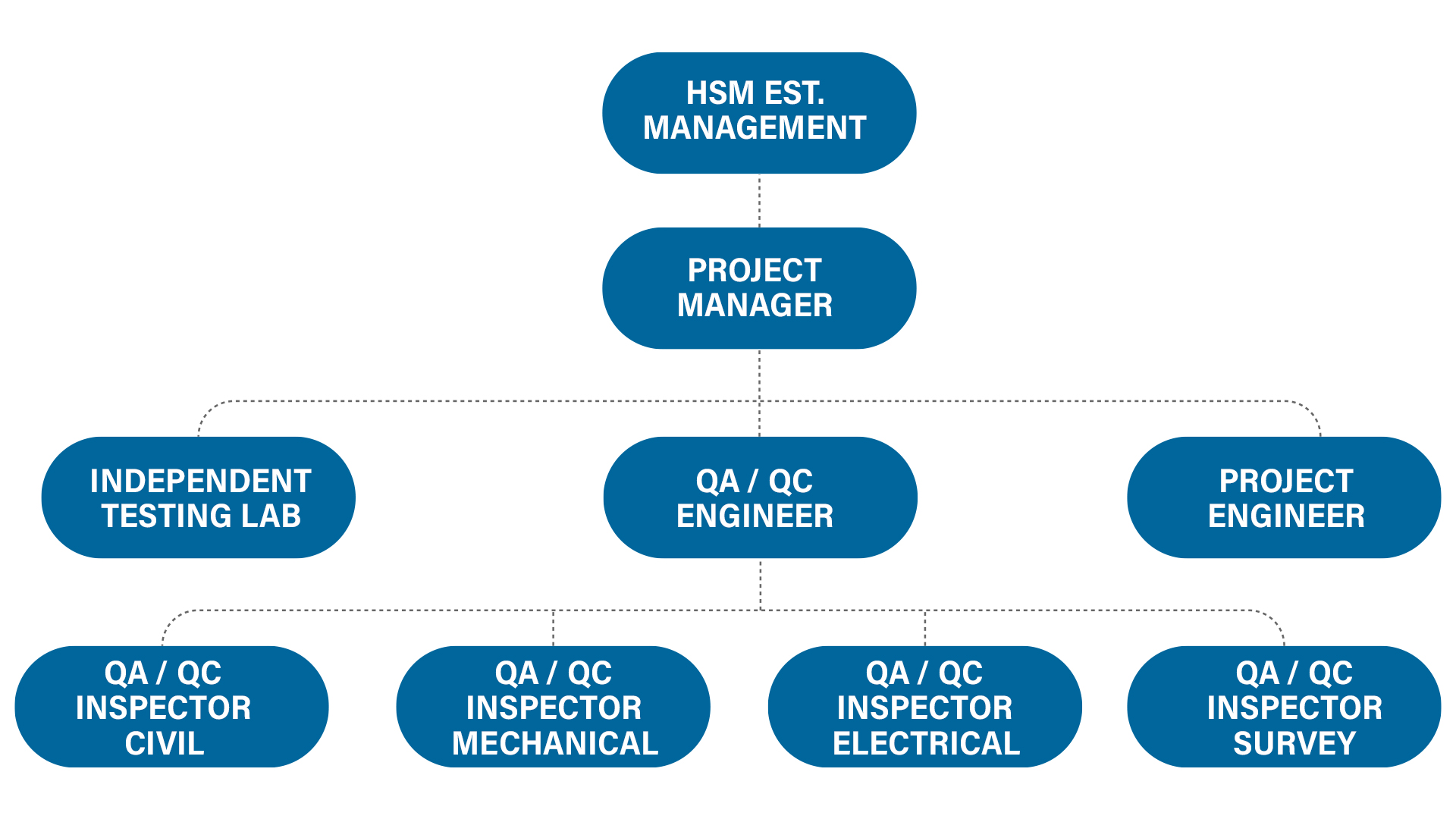
SAFETY ORGANIZATIONAL CHART
COMPANY’S POLICY STATEMENT
It is the company’s policy to implement the Loss Prevention Program, to prevent injuries and damages to property on and off the job.
Company only employs qualified manpower and efficient equipment to meet operating, maintenance and services requirements.
Company believes that the accident and losses can be prevented.
The following pages detail our standard Loss and Prevention
Policy program, which are strictly to all HSM Est. personnel.
SAFETY POLICY
All personnel are requested to observe the following basic rules.
- Follow instructions. Don’t take chances if you don’t know, ask.
- Correct or report unsafe conditions.
- Help keep everything clean and tidy.
- Use the right tools and equipment for the job. Use the safely.
- Report all injuries. Get first aid promptly.
- Uses adjust and repair equipment only when authorized.
- Use prescribed protective equipment, wear safe clothing and keep everything in good condition.
- Don’t horseplay. Avoid distracting others.
- Beware of the danger of fire. Know your fire drill.
- Comply with all safety rules and signs.
- Wear safety helmets and safety shoes and western safety overalls.
- Ear muffles must be worn when using jackhammers, rock
- breakers and other equipment producing high frequency sounds.
- Safety gloves and safety goggles must be worn when required for protection.
- Welders must at all times use welding mask, industrial gloves and protective aprons.
- All personnel using hand and power tools must make sure the following instructions are followed:
- Voltage shall not exceed 110V.
- All electric tools shall be properly grounded by the use of 3 core cables, unless double insulated appliances are used.
- Connection to socket shall be made by proper plugs-no bare wore connections or taped joints will be permitted at any time.
- All power tools must be disconnected from power source before changing grinding disc / blades or drill bits.
- All power tools must be disconnected from power source when stopping the work.
- Scaffolding – All persons using scaffolding are required to comply with the following:
- All scaffolding to have guard rails.
- All mobile scaffoldings shall have lockable wheels, which will be locked when in use.
- All persons will leave the mobile scaffoldings while it is being moved.
- All scaffoldings to be inspected by designated Safety Officer before being used.
- Ladders are to be the correct length, will be tied at all times.
- Smoking – if you have to – only in the designated areas will be permitted.
All personnel please note:
Persons failing to comply with the above will be liable to a fine suspension from work without pay for a period of dismissed form from the company’s employment, depending upon nature of the offense.
The management decision on any such cases will be final.
Please let us keep HSM Est. a safe company to work with and be proud of, after all it is YOUR LIFE, which is at stake.
ASSIGNMENT OF RESPONSIBILITIES
- The overall responsibility for Loss prevention program shall be that of the Project Manager assigned to the contract.
- All matters concerning or deriving from Loss Prevention Program will be channeled though the Site Superintendent for the implementation and enforcement of the program to all levels of supervision.
- The coordination and execution of the program will be the responsibility of the Safety supervisor.
- All supervisor personnel will be responsible for seeing that the men under their control adhere to all the corresponding safety instructions contained in this program.
- Full cooperation from all levels of supervision as well as total employee participation is expected to achieve successful safety standards.
LOSS PREVENTION GUIDLINES
The following instructions and guidelines are being issued in an effort to protect and to provide safe working conditions to all HSM Est. employees. By no means ate these guide norms outlines in this program will minimized hazardous conditions and will help our workers understand our concern on safety matters. It is the intention of HSM Est. to adhere to the regulations as established in Safety Program.
SAFETY ORGANIZATIONS
- Safety Supervisor Work Guidelines.
- Advise management on damage and injury prevention, improve existing work methods and on legal contractual requirements affecting safety, health and welfare.
- Determine the cause of any accident or dangerous occurrences and recommend means of preventing recurrence.
- Analyze information on injury or damage report including overall safety performance.
- Keep up-to-date with recommend codes of practice and safety literature and circulate information applicable to each level of employees.
- Attend job progress meetings where safety is an item number one on agenda. All meetings should be attended so that the Safety Supervisor will know in advance what construction hazards may be expected soon.
- Coordinator of program will all craft supervisors.
- Inspects site conditions and equipment not less than weekly.
- Submit injury and damage reports to the safety supervisor.
- Prepare and keep records of safety reports and safety discussions submitted from site.
- Site Safety Engineering Work Guidelines.
- Inspects the job-site daily and report and correct unsafe acts and conditions.
- Keep permanent record of all injuries and damage at the site.
- Keep record of weekly safety meetings on site with the subject and attendance.
- Prove copy of reports to safety Supervisor regularly.
- Monitor need for, and receipt of, Work Permits as required.
- Site Superintendent.
a. Understand the company’s policy and appreciate the responsibility allocated to each grade of supervision.
b. Know the requirements of Safety program and relevant part of the workmen regulations and ensure they are observed.
c. Ensure that working conditions and welfare facilities are adequate and reasonable.
d. Determine before starting construction the following:
d.1.) Safe work methods
d.2.) Designation of responsibilities to each level of employees. d.3.) Facilities for welfare, first aid and sanitation.
d.4.) Access, storage areas and other related items. d.5.) Work-Permit procedure and certified personnel. d.6.) Basic Fire Precautions.
4. Craft Supervisor.
a. Conduct safety discussion at least 30 minutes per week.
b. Give precise instruction on responsibilities for correct work methods and sequences.
c. Familiarization with work permits requirements.
d. Ensure that all craftsmen observe safety habits and thoroughly trained for their job or craft.
5. Medical Nurse or Qualified Medical Attendant.
Nurse or Qualified Medical Attendant shall be available at the job site or in Camp, in accordance with the requirements of HSM Est. Safety manual and shall be responsible for the following:
a. Perform major first aid treatments on and off the job site.
b. Recommend if patient needs further treatment by a Doctor.
c. Maintain adequate supply of first aid materials and equipment.
d. Maintain availability of an emergency transportation. (Ambulance)
e. Recommend to Safety Supervisor ways and means of preventing injuries and accidents and minimizing its recurrences.
f. Accomplish and keep records regarding required reports.
6. Labor Work Guidelines.
a. Use correct tools and equipments for each type of job.
b. Use protective equipments suitable for each kind of job.
c. Keep tools in good repair.
d. Refrain from horseplay, abuse of safety devices and equipment and welfare facilities.
e. Maintain good atmosphere on work conditions.
f. Do nothing to endanger self or workmates.
7. Security Work Guidelines.
a. All watchmen shall be available at the job site.
b. All contractor’s equipment to be used on the project shall be properly marked and identified.
c. All vehicles entering and leaving job site / storage are shall be registered.
d. All visitors shall be logged on “Visitor’s Register” authorized by Site Superintendent.
8. General Safety Rules for Workers.
The following safety rules are established for all workers use:
a. Familiarize yourself with the area you will be working at.
b. Do not hesitate to inquire to your Supervisor about working conditions and facilities, which may be available in your work area.
c. Make sure before you start working that you are wearing the adequate protection for the kind of work that you perform, in addition to the basic PPE i.e. Safety helmet, Safety Footwear, Personal Clothing.
d. Always check before you start working if you are wearing faulty or damage safety devices.
e. Practice good housekeeping in your work area. Pick up your tools. Do not leave materials and scrap where they will be hazardous to others.
f. Do not enter to areas where warning signs advise you to that effect, unless advise to do so.
g. Do not interface with the work of others, especially where heavy equipment is being utilized.
h. Do not attempt to operate equipment, which you are not completely familiar with.
i. Make sure that heavy equipment operators are aware of your presence in the area. Do not come to where heavy machinery operates unless advise to do so.
j. Be always alert at your work in order to prevent other from engaging in unsafe practices.
k. Report unsafe equipment, hazardous conditions and unsafe acts to your supervisor. Above all, follow the instructions closely as your activity may endanger fellow workers or nearby equipment and materials.
l. If you’re a driver, make sure that you are familiar with the roads you travel of and have the necessary information map, etc. keep always your superior or you workmates informed of your destination, arrival and departure.
9. Safety Inspection Procedures.
The following is a summary of the safety inspection responsibilities of various personnel:
a. Safety Supervisor shall do inspection on jobsite regularly, inspect and record fire extinguishers – replace as required.
b. Craft Supervisors shall see to it that craftsmen wear appropriate and adequate protective equipment on each specific job.
c. Project Manager to do inspection regularly and discuss with the Site Superintendent or Safety Supervisor any problems or hazard found on the site and implement immediate remedial action.
d. Medical Nurse shall see to it that all medical supplies and equipment are maintained at all times both on the Central Site and on each job location.
e. The Medical Attendant shall inspect his kit and all other safety equipment if they are adequate, appropriate or in good repair or condition.
10. Monitoring Safety on Site.
a. The Site Superintendent monitors the safety achievement on site on weekly basis
b. The Site Superintendent will hand over the safety evaluation sheet to the Project manager and in turn will passed to the Managing Director at the Head Office for review.
c. At Company’s Site Superintendent and Engineer meeting at head Office Safety Standards of each site will be reviewed and corrective action taken as required if problem areas are found.
11. Emergency Procedures.
a. Signs in Arabic, English and other languages setting out exactly what each employee should do, in the event of fire or disaster will be erected at site. Assembly areas will also be identified.
b. All new employees entering the job site will be made aware of all firefighting equipment available.
c. Fire drills as and when the particular situation on site requires will be arrange on a regular basis.
d. In case of an major disaster on the Site Superintendent shall insure all levels of site management know that the job site must be immediately evacuated. Of necessary an alarm bell would be provided to expedite evacuation.
e. Existing emergency procedures will be disseminated to all concerned.
12. Protective Equipment and Sanitation Arrangements.
Safety devices will be available for use at site at all times. All personnel at site will be requested to wear the appropriate equipment according to the type of work.
a. All field personnel including visitors are required to wear hard hats in the field.
b. Dusk mask and goggles to be kept handy at all times.
c. Gloves must be worn when handling objects with rough surface substance, which could cut, tear or burn the hands.
d. Proper eye protection must be worn when exposed to flying objects, dust, chemicals or harmful rays.
e. Safety shoes or rubber boots for work in concrete, mud or water must be worn.
f. Toilet and washing facilities are provided on the job site to make use of these.
g. Drinking water from the nearest portable source will be delivered to the site in approved drums or water containers. Containers marked “Drinking water Only” to be used. A supply o paper cups and trashcan at each location will be available.
13. Burning and Welding Operations.
Welding and burning operations have high potential for personal injuries and fires. When doing either of these precautions will be followed:
a. Before starting to burn or weld, work area must be inspected to insure that sparks or molten metal will not fall on combustible materials. Scaffold platforms are combustible and must be protected.
b. Suitable fire extinguisher must be available from the work area and that is operational.
c. Welders, workers are responsible for maintaining the burning or welding equipment in safe operating conditions.
d. When burning or welding, approved eye protection with suitable lenses must be worn and also suitable clothing or protective gloves and aprons.
e. Welding leads and burning hoses must be kept up off floors, walkways and stairways. Workers are responsible for seeing that the equipment complied with safe practices at all times.
f. Never weld or burn on barrels, tanks, piping or other system, which may have contained either combustible or unknown products without first obtaining approval from safety representative or other responsible authority.
g. Welders will be required for:
h.1.) When eyes are exposed to flying objects from chipping or other weld-cleaning activity, they must wear approves eye protection.
h.2.) When arc-weld is used near other workmen, they must be protected from the arc rays by non-combustible h.3.) The frames of all welding machines must be grounded.
h.4.) When a crescent or special wrench is required to operate the acetylene cylinder valve, the wrench must be kept in position on the valve.
14. Burning.
Matches must not be used to light torches, Spark igniters must be used. Torches must not be used to light smoking materials.
15. Storage and Handling of Cylinders.
a. The protective caps must be kept on all cylinders not in actual use.
b. All Cylinders must be properly secured in the vertical position to prevent from tipping and do not use as rollers or any work support.
c. Oxygen and acetylene (or other fuel gas) cylinders in storage must be separated from each other by 20 feet or by at least 5 feet burner, which has 1 hour fire rating.
d. Cylinders must not be taken into confined spaces.
16. Storage and Handling of Cylinders.
a. The protective caps must be kept on all cylinders not in actual use.
b. All Cylinders must be properly secured in the vertical position to prevent from tipping and do not use as rollers or any work support.
c. Oxygen and acetylene (or other fuel gas) cylinders in storage must be separated from each other by 20 feet or by at least 5 feet burner, which has 1 hour fire rating.
d. Cylinders must not be taken into confined spaces.
17. Ventilation and protection.
a. Welding, burning and heating performed in confined spaces may require general mechanical or smoke and fumes to acceptable levels in accordance with confined spaces entry procedures and permits.
b. If adequate ventilation cannot be provided, employees
must be provided with, and required to use, air supplied apparatus.
c. When welding, cutting or heating metals having toxic significance such as zinc, lead, cadmium or chromium bearing metals, you must wear filter type respirators suitable for the hazard must be worn.
18. Sand Blasting and Spray Painting.
a. In all sand blasting operations, the operator and workmen around will compulsory use the following protective gear.
a.1.) Indoors:
Operator and Other Workmen = Hood airline, coveralls, leather gloves and ear protection.
a.2.) Outdoors:
Operator = Hood airline, coveralls, leather gloves.
Other Workmen = Respirator, face shield, safety goggles, coveralls and leather gloves.
b. Sand blast nozzles will be equipped with a control shut off of the “DEADMAN” variety to reduce hazards if the hose is dropped. The blast nozzle and hoses will be electrically grounded to prevent static electrical discharges or shocks for operating personnel.
c. Both operator and other workmen in the vicinity will always wear ear protection.
d. Spray painting will never to be done either on or near surfaces hotter than summer ambient temperatures or near open flames. When spray painting is being done, particularly in confined areas, adequate ventilation will be maintained and barricade area, with signs also displayed.
19. Fire Protection and Prevention.
a. Firefighting equipment will be made available to maintain an adequate Fire Prevention Standard.
b. Additional units will be installed in the more fire hazardous areas such as carpentry shop, welding shop, mechanic shop, and fuel distribution area.
c. Clearly visible “NO SMOKING” and “FIRE” warning signs will be posted throughout the restricted areas.
d. All flammable liquid and gases will be adequately segregated from the living and office quarters in order to minimize hazardous conditions.
e. Fire fighting instructions will be distributed in written form on the use of the firefighting equipment available and exercise will be made as to how to actually use it.
f. In accordance with SAG firefighting equipment laws, all vehicles will carry a fire extinguisher in a visible area.
g. Fire water system will be placed in operation at the beginning of construction.
h. Compressed gas cylinders are to be:
▪ Stored upright with caps and plates.
▪ Stored out of the direct rays of the sun.
▪ Securely fastened to prevent tipping.
▪ Installed on carts or frames preparatory to and during use.
(i) Gauges are to be accurate and in good repair.
(ii) The main tank valve is to be closed, faucets and valves bleed of pressure, then those valves closed, when the set up is not in use.
20. Maintenance and Equipment Inspection.
a. Prior to the commencement of any work, all equipment will undergo a thorough inspection to satisfy the latest applicable safety standards required by Saudi Arabian Government.
b. Saudi Arabian Government Laws Inspection requirements will be met all the times prior to the mobilization of equipment to the job site.
c. It will be the responsibility of the Plant Supervisor to implement and enforce maintenance procedures for all the company’s equipment.
d. Maintenance inspection will be made at least once every 30 days or 3,000 KM for all road vehicles.
e. At the end of workday, every piece of equipment will be properly parked in accordance with the latest applicable safety procedures.
f. All Heavy Duty equipment such as Cranes, Rollers, etc. will have valid Saudi Arabian Government certificate.
21. First Aid Facilities.
a. First Aid Room will be available at the site for the duration of all field works.
b. The First Aid Room will be adequately supplied with the necessary equipment to provide adequate first aid to injuries deserving immediate treatment.
c. At least one ambulance will be available at site in order to transport and injured personnel requiring extensive medical treatment.
d. One qualified medic and an assistant and qualified first aid personnel are available at the camp and / or on site to cover all emergencies and routine treatments.
e. A permanent record will be kept at the field to maintain current information on the number of injuries treated and accidents causes.
f. Individual records will be kept for all personnel with their treatment history as it develops on the job.
22. Safety Reports and Records.
Reporting Procedures for all accidents, personal injuries and casualties, fire and damages, will be implemented as follows:
a. We will ensure that an immediate oral report is made to the company representative in the case of all injuries, damages and accidents.
b. All fatal accidents and injury cases will be satisfactory investigated and reported in written form.
c. All events involving damage to the company property plant and equipment will be made subject to a written report.
d. Meetings will be held at the supervisory level, to discuss Safety Matters, Injury Prevention and Loss Control Practices will be mounted.
e. HSM Est. contractors Loss and Prevention requirements will be adhered to on all matters concerning personal injuries and accident reporting. Likewise on the compliance of routine reporting as detailed below:
SAFETY REPORTS:
e.1.) Weekly Reports
• Craft safety discussion and meetings (see attached contractor’s Safety Discussion Form)
• Accomplish and submit to Project Manager during weekly safety attendance.
e.2.) Monthly Reports
• Summary of weekly safety meetings.
• Injury and damages summary. (each occurrence)
• Damage and motor vehicle collision summary.
e.3.) Other Reports
▪ Motor Vehicle Collision Report. (as occurrence)
▪ Supervisor’s Report on a job related injury or illness (as occurrence).
▪ First Report of occupational disabling injuries and illness.
▪ Statement Form (witness / involved party)
f. One copy of all the above-mentioned written reports will be maintained in the Field Office on permanent basis.
23. Licenses and certifications.
a. Prior to the commencement of works at the job site, Site Supervisor will have to obtain a work permit.
b. All heavy equipment and vehicle operators prior to the commencement of work, will be trained and have to obtain the valid license and certificate for the operation of heavy equipment and vehicles i.e. cranes, etc.
c. All drivers of company vehicles will be in possession of a valid Saudi Arabian driver license before they can operate any vehicle. Failure to comply with this requirement will result in the immediate dismissal of the individual involved.
d. Welders and high voltage splicers will have valid certificates prior to start the work.
24. Safety Training Program.
a. Toolbox meetings will be held at least once a week and conducted by Foreman representative in conjunction with the Safety Supervisor New Regulations and Procedures should be explained at these
meetings as well as safety matters concerning the specific work being performed. Every effort should be made to satisfy the worker’s question on related matters.
b. Supervisor’s Safety Meetings will be conducted by the Safety Supervisor at least once a month. At these meetings, all new procedures and regulations will be explained and discussed with the attendants. The supervisory personnel should bring forward their comments about unsafe conditions and their opinions concerning course of action. The safety supervisor will minute these meetings and will see that corrective action is taken whatever it is necessary to maintain adequate safety standards.
c. Permanent records will be maintained of all meetings in accordance with established procedures.
d. All newly arrived employees will be given a brief talk on the Safety Program along with a copy of the program.
e. Meetings will cover topics as listed in the Safety Agenda, which will cover the following areas of concern:
e.1.) Work Permit
e.2.) Personnel Protection e.3.) Excavation
e.4.) Housekeeping
e.5.) Welding and Cutting e.6.) Hand and Power Tools e.7.) Working Places and Access e.8.) Electricity
e.9.) Lifting and Rigging e.10.) Mechanical Equipment e.11.) Plant Operation e.12.) Radiography
e.13.) Transportation e.14.) Desert Driving e.15.) Fire Prevention e.16.) Emergency procedures e.17.) First Aid
e.18.) Environmental protection e.19.) Welfare and Sanitation
As separate safety agenda will be prepared for each site along with dates and the program of meetings will be monitored by the site superintendent.
25. Access to Work Place.
a. Portable straight ladders should be firmly placed on secure footing. If these danger of slipping, they should be held by a fellow worker or lashed in placed.
b. When necessary to place ladders in front of a doorway, the door should be locked or guarded.
c. Barrels, boxes, chairs or crates shall not be used in place of stepladders. Portable steps must be used as working platforms.
d. Always face the ladder and hold on with both hands whether climbing up or down.
e. Running scuffing or crowding on stairs is not allowed.
f. Built-up scaffolds shall be constructed and inspected each shift by experienced personnel.
g. Do not sit, lean or rest on or against any railing or lift lines.
Tools and materials must not be left unsecured in any elevated place. When practicable, the area beneath overhead operations should be roped-off, and make with warning signs.
h. Portable leads or air hoses should not be run down ladders or across ladder landings.
26. Temporary Electric Supply.
a. Installations of temporary electrical installation will be carried out by experienced qualified electricians and will conform to all applicable standards.
b. Before connecting temporary electrical installations to existing installations prior approval must be obtained from the electrical engineer.
c. The layout of the temporary electrical installation will be so as to avoid as far as possible the need for use of long extensions leads or for re-routing or extension of main cables during course of construction. This will be achieved by sitting panel boards at regular and convenient positions around the site.
d. Any alterations extensions to the temporary electrical system, must first be approved by the site superintendent prior to being carried out and will on be undertaken by approved experienced technician.
e. A routine inspection program for the temporary electrical system, its usage and maintenance to be established and will be carried out by the site safety officer and an electrician authorized by the site superintendent to undertake any necessary repairs, maintenance and alteration.
f. All 120 Volts, Single Phase, 15 & 20 Amps, receptacle outlets which are not part of the permanent wiring of any buildings or structure will have ground fault circuit interrupters for personal protection.
27. Excavation Depth.
a. Prior to any excavation commencing the type of excavation is to be reviewed to establish the safety measures, which have to be implemented.
b. Any shoring timbering or support work for trenching or other excavation will be designated by an experienced qualified person to meet requirements and other applicable engineering standards set by the company.
c. All materials used for shoring to be in good serviceable condition and in the case of timber free from any large of loose knots.
d. All excavations and shoring will be inspected daily by safety officer to ensure that there is no danger or collapse.
e. All spoil arising from excavation will be stockpiled a minimum of 2′-0″ from the edge of trench.
f. Walking will not be allowed in any area of excavation where workmen could be struck by any part of mechanical excavator.
g. A safe and swift means of getting out of excavations will be provided at intervals not exceeding 50 feet. Ladders must be of timber or metal construction set at an angle of 75 degrees and extends 3.0″ above the trench top.
h. Markers will be provided along edges of excavations where there is any likelihood of men and machines falling in. where appropriate – i.e. in areas subject to constant personnel or machines traffic substantial barriers will be erected and at night warning lights used.
i. An excavation of 4 feet or more deep is considered a confined space and a confined space entry permit is required, before work starts.
j. In order that excavation work may be undertaken with minimum risk to men, plant and equipment, and to enable the work to proceed without interruption the following factors must be considered well before the job starts:
j.1.) Size and purpose of the excavation.
j.2.) Nature of the ground including the proximity as any made up ground.
j.3.) Proximity of adjacent structures.
j.4.) Position of underground obstructions such as pipes and cables.
j.5.) Weather and moisture conditions. j.6.) Sources of vibrations.
j.7.) Adjacent roads and footpaths. j.8.) Method of excavation.
Consideration of these factors will indicate the safety measures,
which must be implemented and whether the sides of the excavation can be sloped back to a safe angle or whether shoring will be require. It is of vital
importance that adequate and suitable shoring material be on site and immediately available for use whenever deep (4 feet or more) excavation work is to be carried out. Excavation work of a depth of less than 4 feet could also
require shoring. Failure to take this precaution is the root cause of the majority of excavation fatalities.
28. Cranes, Lifting Equipment.
a. Fiber / wire slings used to support a human load are to inspected before each use. Visual inspection will be made for abrasion, broken fibers, cuts, fraying or any other defects. Those found defective under such inspection and examination will be removed from such service and tagged to warn other users prior to being removed and destroyed.
b. Ropes, cables and chains are not to be used for stresses in excess of allowable safe loads.
c. Wire ropes or cables will be inspected at the time of installation and once a week thereafter when in use and remove from service when
found defective and tagged to warn other users prior to being removed and destroyed.
d. Connections, fittings, fastenings, parts, etc. used in connection with ropes, cables, or chains, are to be in such quality and strength as to provide safety factor of not less than four. Manufactured standard connections shall be used.
e. Running lines of hoisting equipment located within 6 feet and 6 inches from the ground or working level, will be boxed, railed off, or otherwise guarded, or the operating area restricted from other workers.
f. Hooks, shackles, rings, pad eyes, slings, etc. that have been bent, or otherwise damaged will be removed from service.
g. All cranes, hoist and derricks are to be equipped with proper dogs on pawl: and barking equipment which will be capable of effectively braking and holding a weight of at least one and one half times the full rated load.
h. Extensions of outriggers will not be permitted unless designed by manufacturer of the equipment on which they are to be used.
i. Capacity places are to be attached to all cranes, hoist and derricks on boom cranes and derricks, they will clearly indicate the safe load in tons for maximum and minimum positions of the boom and for at least two intermediate stations. These indicators will be for load both with and without riggers.
j. There are to be least two full wraps of cable on drums of cranes, hoist and derricks at all times of operations.
k. Riding on loads, hooks. Hammers, material, hoist or buckets. Except especially devised equipment for elevated work when all
employees are equipped with safety belts properly secured, is prohibited.
l. Loads and buckets, etc. are not to be made swung over the head of workmen.
m. While hoisting equipment is in operation, the operator will not be permitted to perform other work.
n. While a load is suspended from crane or derrick, the operator is not allow to leave his position at the control until the loads has been landed.
o. Side pulls will not be directly over the load to be lifted.
p. All slings, cables, chains and other gear used in connection with cranes, hoist and derricks, will be under supervision and maintained by properly qualified persons.
q. A notice will be posted in the can of every derrick, crane, dragline, etc. prohibiting the operator from bringing the boom or other part of the machine within 25 feet of high voltage wires.
29. Flammable Liquid Storage.
a. All storage, handling or use of flammable liquids/ materials will be under the supervision of qualified persons. No one shall be permitted
to handle or use flammable liquids/ materials until he has been instructed in the safe handling and use of the same.
b. All sources of ignition will be prohibited in areas where flammable are stored, handled and processed. Suitable warning “NO SMOKING” signs shall be posted in all such areas.
c. All spills of flammable liquids will be cleaned up immediately.
d. Flashlights and electric lanterns used in connection with handling of flammable will be the type approved by the Underwriter’s Laboratories Inc.
e. Purging – Gas Freeing: No person is to be permitted to enter a storage tank, tank truck or other vessel which has contained flammable until such vessel has been properly purged and ventilated. After purging and venting, a test shall be made for gas. If vessel is not gas free, purging and venting will be repeated.
f. All persons entering storage tanks, tank trucks or other vessels, which have contained flammable liquids or gasses will be provided with necessary protective clothing, approved air fed masks, safety belts and lifelines. An attendant will be stationed at the entrance to such tank or vessel.
g. No welding, cutting, riveting or hot work and no mechanical repairs are to be performed on a storage tank, gasoline tank, gasoline trunk or other vessel which has contained flammable until such vessel has been properly purged and ventilated. After purging and venting a test will be made for gas.
h. Welding, cutting, riveting or hot work on tank or containers, which have contained flammable liquids or gases, will be performed only by men experienced in such work.
i. All tools used in explosive atmosphere are to be non-sparking variety.
j. Storage tanks and systems will be electrically bonded and grounded in an approved manner.
k. All storage tanks above ground will be dike, curbed or other suitable means provided to prevent the spread of liquids to other property in
case of rupture in tank or piping. Such dike or curbed area is to have a capacity equal in volume to that of the tank.
l. Outlet tanks above ground will be equipped with quick closing valves.
m. All gasoline trunks will be properly bonded and grounded while being loaded or unloaded. Bending and grounding connections are to be made before covers are removed on trucks and shall not be disconnected until such covers have been replaced.
n. Accumulation of flammable materials on floors, wall, etc. will not be permitted.
o. Bungs caps or stoppers will not be left out of drums, barrels, or other flammable liquid containers.
p. All tanks, hoses and containers will be kept in metallic contact while flammable liquids are being poured.
q. Approved type dry chemical fire extinguishers are to be provided at all locations where flammable are stored, processed or used.
30. Pressure Testing procedures.
a. Any person in-charge on any pressure test work shall be aware of the requirements for such testing as set out by the company.
b. All persons working on or in vicinity of test must be informed of the possible hazards and the necessary precautions to take.
c. All pipes and vessels being tested must be adequately supported including providing temporary supports and bracing if required.
d. No one is to be allowed near equipment under test when the pressure is near the yield strength or pressures of over 500 psi are being applied.
e. Only calibrated test gauges to be used and should be mounted in an upright position.
f. Safety precautions will be made to meet the requirements of GI.2.102.
31. Cartridge Operated Tools and Cartridge Control.
a. Cartridge operated tools must only be specified individuals who have undergone thorough training in the use of such tools and are aware of all hazards associated with them.
b. All cartridge tool users must wear full-face protection and earmuffs when operating the tool.
c. Inspection of the material to be operated must be made prior to operation and a careful assessment made of the correct size and strength of cartridge needed.
d. It is very important that the correct size cartridge is used and that is appropriate for the tool being used.
e. Operators should take particular care to avoid fixing devices penetrating through the material into thin air.
f. All personnel should be made aware when cartridge tool operation is to commence and in which location.
g. Operators should ensure that no one is working directly under or direct line of the fixing device.
h. If the material being fixed in liable to splinter protective screens must be erected or the area around cleared of all other personnel.
i. When working off ladders; scaffolding or ledges – extra care must be taken in case of the tool recoil after firing.
Storage:
j. All cartridge tools must be kept in a clean dry room in lockable box and a register for such tools maintained.
k. Daily, the person designated responsible for maintaining the tools must record the name of the individual allocated the tool must records its return.
l. Cartridge shall be similarly stored and the number and strength of each issue shall be corrected.
m. A record shall be maintained for each tool showing when it was overhauled, when any repairs were carried out and who carried out the repairs. All such tools must be thoroughly overhauled and tested at least manually.
n. When cranes are used handling materials, only one person should signal the operator, as the signals from different persons may cause confusion and accident.
o. Never ride with the materials being lifted by crane or hoist.
p. When placing materials upon ground or floor that is not level, the base elements must be properly blocked to make sure that pile will not shift.
32. Material Handling and storage
The following safety procedures would be made available for all personnel involved with material handling and storage.
a. Never stand under suspended loads or material being hoisted.
b. Never overload beyond its rated capacity and device for handling transporting materials 9crane, trucks, elevators, hoist, etc.)
c. Never operate with excessive speed of any device for handling and transporting materials. Speed limits to be obeyed.
d. To avoid painful back injuries, lift with your legs not with your back, bend your knees and keep your back straight.
e. Just as in machine, your body cannot take overload. No person would attempt to lift or carry load beyond his strength and ability. Get Help!
f. When carrying long objects on shoulder, (one-man-carry) raise the forward end to clear view especially when rounding corners and going up or down stair ramps.
g. Coordination of persons when lifting, transporting and lowering material is very important. Have only one person to call out orders.
h. Two or more person carrying long materials must always transport on the same shoulder.
i. Never pile materials too high, that it will render un-operative fire control equipment, lighting fixtures, etc.
j. When storing materials, make sure that the floor will support the weight and that enough clearance from the walls will allow passage from firemen in case of fire.
k. Do not store materials on passageways even on temporary basis, but not safe location provided for the purposes.
33. Off the Job Safety
CONTRACTORS CAMPS & COMPOUNDS
SAFETY:
The company employs a team of maintenance workers to
ensure that all the company facilities are maintained to meet specified mandatory standards where applicable and to keep the properties in good repair and safe for use.
The maintenance team comprising of, electrician, plumbers and carpenter jointers are under the control of the company administration and personnel department.
The Administration and Personnel Department conduct
regular inspection of premises to check, in particular on the condition of electrical installation and plumbing sanitary facilities.
All employees are made aware of good practices to be observed in the usage of electrical equipment and land notices are displayed in prominent positions in all camps and compounds to alert and warn employees of potential hazards.
34. Driver Safety and Training Program
All company employees who are authorized to drive anyone company vehicles must be in possession of a valid Saudi Arabian Driving License.
In addition all drivers of any specialized vehicles will have required license endorsements and will in addition have attended Safety and Training Courses for such vehicle.
All employees are notified of the legal requirements for road users and a list of infringements and penalties is distributed and prominently displayed.
Posters are displayed in offices, camps and work site advising of potential hazards and good driving practices. Supplemented at periodic intervals
by specific advice and warning issued by the company administration department.
All company vehicles are maintained in house by the company workshops to meet as a minimum the specified requirement of the manufacturers – particular attention being paid to brakes, steering and lighting.
All employees are encouraged to “drive defensively” and to expect the unexpected.